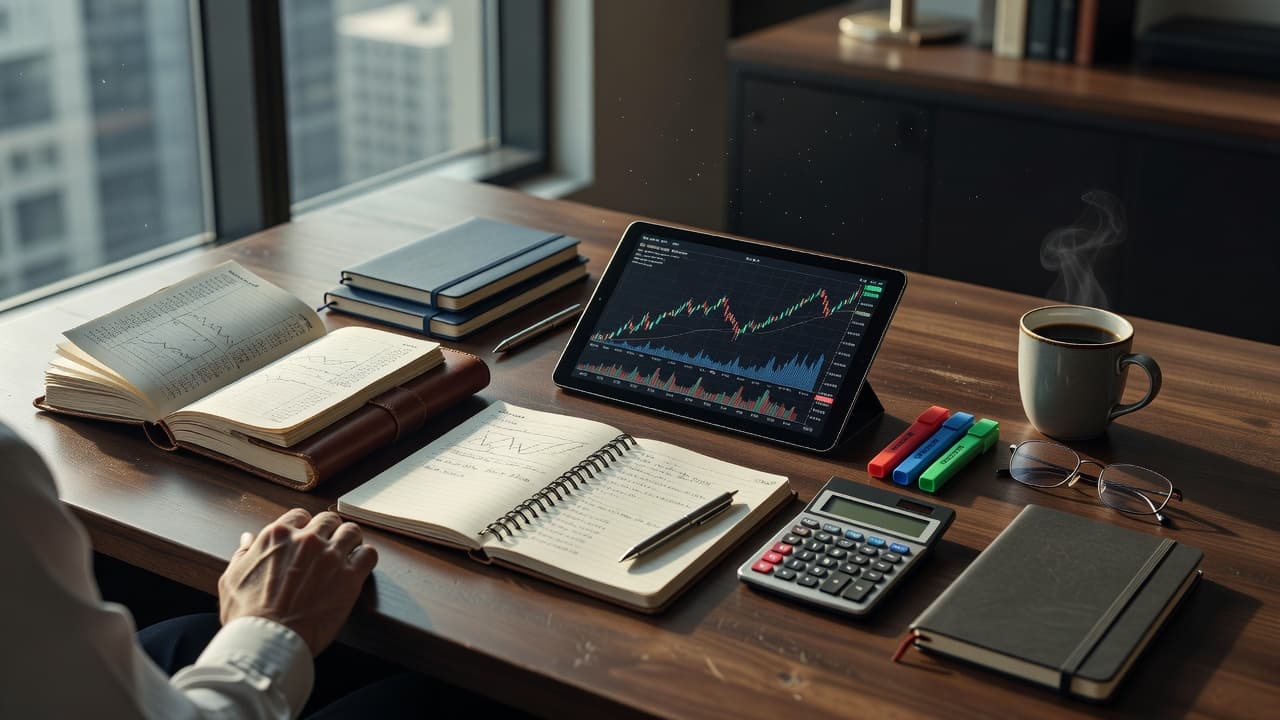
Trade Planner for Day Traders: Plan, Simulate, and Review Every Session
A day trading journal built into a simulator changes everything. Learn how Trade Planner helps day traders prep sessions, execute with discipline, and review every trade.
TL;DR: A day trading journal is only as powerful as the process around it. Trade Planner combines pre-session planning, live simulation, and structured post-session review into a single workflow — so every day trade you take teaches you something, whether you win or lose. Traders who journal and simulate consistently outperform those who wing it, and Trade Planner makes both habits automatic.
Key Takeaways
- Traders who maintain a structured day trading journal improve their profitability by an average of 30% within the first year of consistent use [1]
- Pre-session planning reduces impulsive trades by forcing you to define setups, risk levels, and invalidation points before the market opens [2]
- Simulation-based practice lets day traders test intraday strategies against real market data without risking capital, cutting the typical learning curve by months [3]
- Post-session review is where the real edge is built — traders who review daily identify pattern failures 4x faster than those who only track P&L [4]
- Trade Planner integrates all three phases — plan, simulate, review — into one platform purpose-built for day traders [5]
Why Do Most Day Traders Fail Without a Journal?
The statistics are brutal and well-documented. A landmark study by researchers at the University of California found that roughly 80% of day traders lose money over a 12-month period, and only about 1% consistently beat the market after fees [1]. The Financial Industry Regulatory Authority has long warned retail traders that day trading is among the highest-risk activities in the markets [6].
So what separates the 1% from everyone else? It is not some secret indicator or a faster data feed. The consistent winners almost always share one trait: they treat trading like a business, and businesses keep records. A day trading journal is the trader's equivalent of a profit-and-loss statement, a quality control log, and a performance review rolled into one document.
Without a journal, you are relying on memory — and memory lies. You remember the big wins and forget the slow bleed of undisciplined entries. You convince yourself that "the market was just choppy today" instead of recognizing that you broke your own rules three times before lunch. The journal strips away the narrative and shows you what actually happened.
Trade Planner was built on this insight. Rather than bolting a journal onto a charting platform as an afterthought, Trade Planner makes the journal the backbone of the entire day trading workflow. Every simulated session begins with a plan and ends with a review, creating a feedback loop that accelerates skill development.
What Does a Complete Day Trading Session Look Like in Trade Planner?
A profitable day trading practice has three distinct phases, and skipping any one of them creates a gap in your process. Trade Planner structures your entire session around these phases so nothing falls through the cracks.
Phase 1: Pre-Session Planning
Before the opening bell, you need to know what you are looking for and what you will do when you find it. Trade Planner's intraday trade planning module walks you through a structured pre-session checklist that covers:
- Market bias: Are you leaning bullish, bearish, or neutral based on overnight action, pre-market levels, and the economic calendar?
- Key levels: Where are the major support and resistance zones, VWAP from the prior session, and any significant moving averages on the daily chart?
- Planned setups: What specific patterns or catalysts are you watching? Opening range breakouts, gap fills, VWAP reclaims, or momentum continuation plays?
- Risk parameters: What is your maximum loss for the session? What is your per-trade risk? How many trades will you take before stepping away?
- Invalidation criteria: Under what conditions will you stop trading entirely — not just stop a single trade, but shut the screens and walk away?
This pre-session plan becomes the contract you make with yourself. Trade Planner stores it alongside your session data so you can reference it during the session and evaluate your adherence afterward. Research from the trading psychology literature consistently shows that traders who write down their plan before the session make fewer impulsive decisions during it [2].
Phase 2: Simulated Execution
This is where Trade Planner's day trader simulator separates itself from a simple spreadsheet journal. Instead of trading live capital while you are still learning, you execute your planned setups in a realistic simulation environment that mirrors actual market conditions.
The simulator feeds you real historical or live-delayed intraday data. You place entries, set stops, manage positions, and take exits exactly as you would in a live account. The critical difference is that mistakes cost you nothing but time and ego — both of which recover faster than a blown account.
During the simulated session, Trade Planner automatically logs every action: timestamps, prices, position sizes, hold times, and the running P&L. It also prompts you to tag each trade with metadata — was this a planned setup or an impulse? Did you follow your stop, or did you move it? Were you feeling confident, anxious, or revenge-minded when you clicked the button?
This metadata is what transforms raw trade logs into a genuine day trading journal with analytical depth. Most traders never capture this information because doing so manually during a fast-moving session is impractical. Trade Planner captures it in real time without breaking your flow.
Phase 3: Post-Session Review
The post-session review is where growth happens, and it is the phase that most traders skip. After the closing bell — or after your simulated session ends — Trade Planner generates a structured debrief that compares your actual trades against your pre-session plan.
The review surfaces critical questions:
- Did you take the setups you planned, or did you chase something else entirely?
- Did you honor your stop losses, or did you give trades "more room" and turn small losses into large ones?
- Did you hit your maximum session loss and keep trading anyway?
- Which trades followed your rules and which ones deviated?
- What was your emotional state during your best and worst trades?
Trade Planner scores each session on rule adherence, not just profitability. A session where you lost money but followed every rule perfectly gets a high score — because process beats outcome over the long run. Conversely, a profitable session built on broken rules gets flagged, because those habits will destroy your account eventually.
How Does Trade Planner Compare to Other Day Trading Tools?
The day trading tools landscape is crowded, but most platforms focus on only one piece of the puzzle. Here is how Trade Planner stacks up against the common alternatives:
| Feature | Trade Planner | Standalone Journal Apps | Broker Simulators | Spreadsheet Logs |
|---|---|---|---|---|
| Pre-session planning templates | Built-in | Some offer templates | Not included | Manual creation |
| Real-time simulation | Full intraday simulator | No simulation | Basic paper trading | No simulation |
| Automatic trade logging | Yes, during simulation | Manual entry required | Partial — logs trades only | Fully manual |
| Emotional state tracking | Prompted during session | Some offer mood tags | Not included | Manual columns |
| Rule adherence scoring | Automated scoring | Not available | Not available | Manual calculation |
| Post-session debrief | Structured review module | Basic notes field | Trade history only | Manual review |
| Historical pattern analysis | Cross-session analytics | Limited analytics | Basic P&L reports | Pivot tables if built |
| Integrated workflow | Plan, simulate, and review in one tool | Journal only | Simulation only | Logging only |
The key differentiator is integration. Standalone journal apps like Tradervue or TradesVault do an excellent job of logging and analyzing completed trades, but they cannot help you practice those trades in a risk-free environment first [7]. Broker-provided paper trading accounts let you simulate, but they rarely include structured planning tools or the kind of granular journaling that drives behavioral change. Trade Planner bridges that gap by treating all three phases as one continuous process.
What Should You Actually Track in Your Day Trading Journal?
Not all journal entries are created equal. Tracking just your entry price, exit price, and P&L tells you almost nothing useful. The data points that actually drive improvement are behavioral, not financial.
The Metrics That Matter Most
Rule adherence rate is the single most predictive metric in a day trading journal. Track whether you followed your entry criteria, honored your stop loss, respected your position sizing rules, and stayed within your daily loss limit. A trader who follows their rules 90% of the time will almost certainly outperform a trader who follows them 60% of the time, regardless of which strategy either one uses [4].
Setup quality grading forces you to evaluate each trade on a scale before you know the outcome. Was this an A-plus setup — textbook pattern, perfect risk-to-reward, strong catalyst? Or was it a C-minus — marginal setup you took because you were bored and needed action? Over time, this grading reveals that your A setups have a dramatically different expectancy than your C setups, and the obvious next step is to stop taking C setups.
Emotional state logging captures the internal variable that no chart can show you. Were you calm and focused, or were you anxious after a morning loss? Were you overconfident after a winning streak? Trade Planner prompts you to tag your emotional state at the time of each trade, building a dataset that reveals your psychological patterns. Many traders discover that their worst losses cluster around specific emotional states — and that awareness alone is enough to break the cycle.
Hold time analysis shows whether you are cutting winners short or letting losers run. The data often surprises traders. You might believe you are patient with winners, but the journal reveals that your average winning hold time is 4 minutes while your average losing hold time is 22 minutes. That imbalance is a classic symptom of hope-based trading, and you cannot fix what you cannot see [2].
What to Skip
Avoid tracking so many variables that the journal becomes a chore. If it takes you 30 minutes to log a single trade, you will abandon the process within a week. Trade Planner's automatic logging handles the mechanical data — timestamps, prices, P&L — so your manual input focuses only on the behavioral and psychological dimensions that matter.
How Does Simulation Accelerate the Day Trading Learning Curve?
The traditional path to day trading competence is expensive. Most traders learn by losing real money, processing the emotional pain of those losses, and slowly adjusting their behavior. A study published in the Review of Financial Studies found that the median individual day trader loses approximately $750 per month, and it takes the average profitable day trader over two years of consistent activity to reach breakeven after accounting for losses during the learning period [3].
Simulation compresses this timeline by removing the financial pain from the equation. When a simulated loss does not hit your bank account, you can analyze it objectively instead of emotionally. You can take 50 simulated trades in a week to test a new setup, whereas in a live account you might only get 10 opportunities — and each losing trade would carry real psychological weight.
Trade Planner's day trader simulator is designed specifically for this kind of deliberate practice. You can replay specific market sessions — the February 2026 sell-off, a high-volatility FOMC day, a quiet summer session with no catalysts — and practice your response to each environment. This targeted repetition builds pattern recognition and muscle memory that translates directly to live trading.
The key is treating simulation seriously. Trade with the same position sizes you plan to use live. Follow your rules with the same discipline. Log every trade in your journal. Traders who treat the simulator like a video game get video game results. Traders who treat it like a dress rehearsal build real skills.
How Do You Transition from Simulation to Live Day Trading?
The transition from simulated trading to live trading is where many traders stumble. The psychology shifts dramatically when real money is on the line, and behaviors that were easy in simulation — holding through a pullback, honoring a stop loss, staying patient for an A-plus setup — suddenly become difficult.
Trade Planner supports this transition with a structured graduation process. Rather than flipping a switch from sim to live, you progress through stages:
- Full simulation: Execute your strategy against historical and live-delayed data. Track everything in your journal. Achieve consistent profitability and high rule adherence over at least 30 sessions.
- Micro-live with parallel sim: Begin trading live with minimal position sizes — one share, one micro lot — while continuing to simulate your full-size positions. Compare your live behavior against your simulated behavior to identify where the psychology diverges.
- Scaled live: Gradually increase live position sizes as your live rule adherence matches your simulated performance. Your journal data tells you exactly when you are ready.
This approach respects the reality that simulation and live trading are psychologically different experiences while giving you objective data to guide the transition. Most traders who blow up their accounts do so because they scaled up too fast, before their process was truly consistent [6].
Why This Matters
As of mid-2026, the retail day trading market continues to grow, fueled by commission-free brokers, fractional shares, and an expanding ecosystem of day trading tools and educational content. The SEC reported a 15% increase in retail trading volume during the first quarter of 2026 compared to the same period in 2025 [8]. More people are day trading than ever before, but the failure rate has not improved — because access to markets has increased while access to structured skill-building has not kept pace.
The traders who survive and thrive in this environment are the ones who build a process around their trading, not just a screen setup. A day trading journal is the foundation of that process, and simulation is the training ground where the process gets tested without financial risk. Trade Planner brings both together in a workflow designed for how day traders actually work — fast-paced, session-based, and emotionally intense.
Whether you are a beginner logging your first 100 simulated trades or an experienced day trader looking to diagnose a slump, Trade Planner gives you the structure to plan every session with intention, execute with discipline, and review with honesty. The traders who do this work consistently are the ones who end up in that profitable 1%.
Sources
[1] Barber, B. M., Lee, Y., Liu, Y., & Odean, T. "The Cross-Section of Speculator Skill." University of California, Davis. https://faculty.haas.berkeley.edu/odean/papers/Day%20Traders/Day%20Trading%20and%20Learning.pdf
[2] Steenbarger, B. N. "The Psychology of Trading: Tools and Techniques for Minding the Markets." Wiley. https://www.wiley.com/en-us/The+Psychology+of+Trading-p-9780471267614
[3] Barber, B. M. & Odean, T. "Trading Is Hazardous to Your Wealth." The Journal of Finance, Vol. 55, No. 2. https://faculty.haas.berkeley.edu/odean/papers/returns/returns.html
[4] Douglas, M. "Trading in the Zone." Prentice Hall Press. https://www.penguinrandomhouse.com/books/95563/trading-in-the-zone-by-mark-douglas/
[5] Trade Planner Platform. https://tradeplanner.ai
[6] FINRA. "Day Trading: Your Dollars at Risk." https://www.finra.org/investors/insights/day-trading
[7] Tradervue. "Online Trading Journal." https://www.tradervue.com
[8] U.S. Securities and Exchange Commission. "Staff Report on Equity and Options Market Structure." https://www.sec.gov/reports
Frequently Asked Questions
Ready to improve your trading?
TradePlanner uses AI to analyze your trades, identify your edge, and build a personalized playbook.
Start Your Free Journal →